
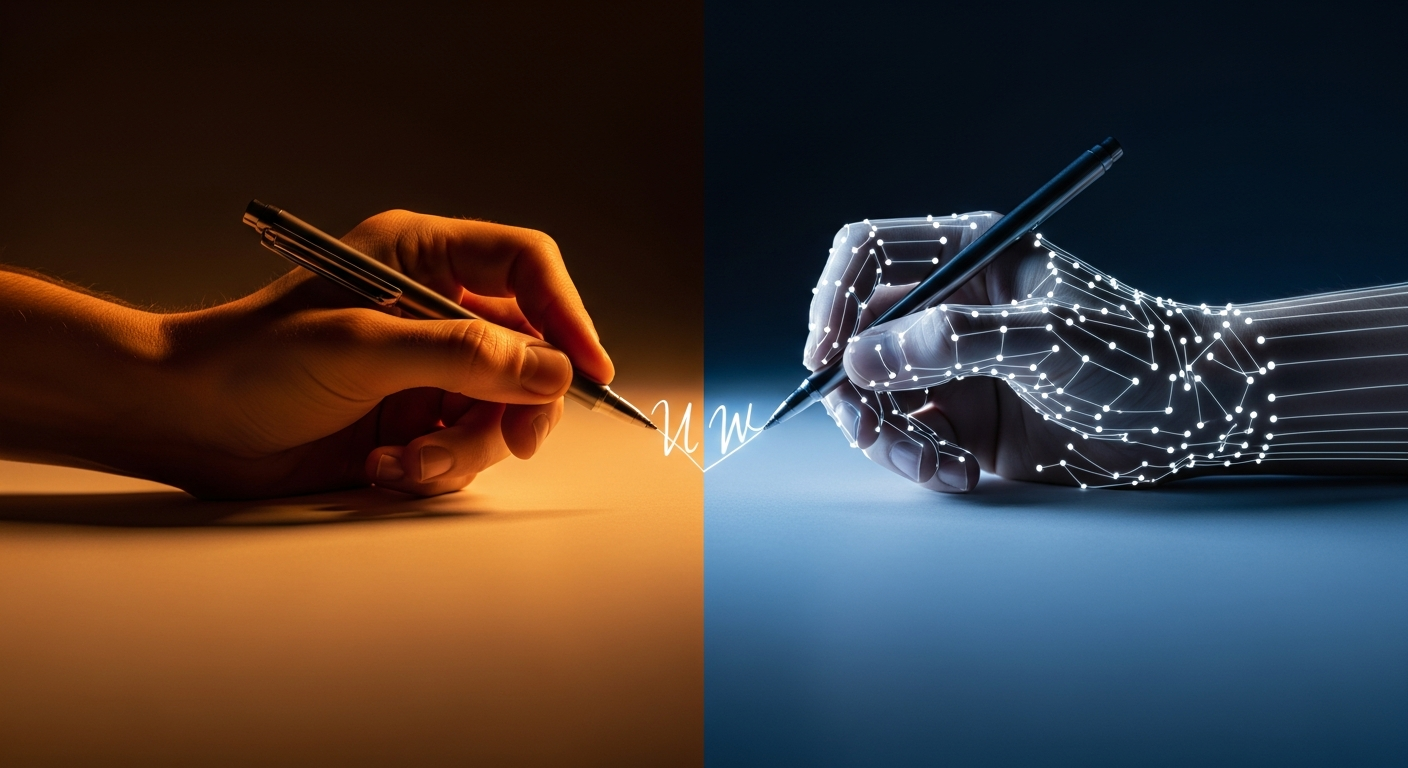
The debate over AI versus human ghostwriting mostly misses the point. The real question—the one executives and their communications teams should be asking—is not which to use. It's when to use each, and how to structure the handoffs so the result is better than either could produce alone.
Getting this allocation wrong is costly. AI doing the work that only humans should do produces content that is forgettable or, worse, damaging. Humans doing the work that AI could handle efficiently is expensive and unsustainable at the volume the current content environment demands.
What AI Ghostwriting Does Well
AI excels at everything structural and logistical in the content production chain. Given a clear brief built on genuine executive perspective, it can produce a well-organized draft rapidly, generate multiple hook variants for testing, adapt long-form content for different platforms, ensure consistency of formatting and structure, and surface relevant supporting data points.
The scale of AI adoption tells part of the story. According to the Content Marketing Institute's 2025 B2B report, 81% of B2B marketers now use generative AI for content production. The tools are embedded in most professional content operations—not because they're replacing human judgment, but because they're eliminating tasks that don't require it.
ChatGPT alone processes roughly 2.5 billion prompts per day from around 900 million weekly users. This is not an experimental technology. It is infrastructure—and it is being used by your competitors whether or not you use it yourself.
Framework: AI Ghostwriting vs Human Ghostwriting — Finding the Right Balance
| Dimension | Human Ghostwriting | AI Ghostwriting |
|---|---|---|
| Voice capture | Deep, iterative, nuanced | Pattern-matched from training data |
| Speed | Weeks per piece | Minutes to hours per piece |
| Cost | $500–$3,000 per article | Fractions of a cent per word |
| Scale | One writer, limited output | Unlimited parallel production |
| Best for | Flagship publications, sensitive topics | Volume content, social cadence |
| Key weakness | Slow, expensive, hard to scale | Needs voice training, misses nuance |
| Ideal use | CEO op-eds, keynote speeches | LinkedIn posts, newsletter editions |
What Human Ghostwriting Does Well
Human ghostwriters provide what AI cannot: the capacity to draw out a distinctive perspective through real conversation, and the editorial judgment to know what's worth saying in the first place.
The most valuable thing an executive can publish is a specific, defensible position—not a summary of industry trends, not a list of best practices, but an opinion that reflects real experience and stakes out a real position. Surfacing that opinion requires a skilled interviewer who can ask the right follow-up questions, recognize when something important is being understated, and push past the safe, public-facing version of a view to find the actual one.
That process cannot be replicated by any prompt. It requires trust, context, and human intuition about what's interesting versus what merely sounds interesting.
"The best AI draft in the world is only as good as the human perspective it started from."
The Trust Gap in AI-Only Operations
The CMI data surfaces a revealing tension: while 81% of B2B marketers use generative AI for content, only 4% highly trust AI outputs, and only 19% have successfully integrated it into systematic workflows. Most organizations have adopted the tools without figuring out the operating model.
The consequence is a massive volume of content that audiences are increasingly able to identify as AI-generated—competent in structure, thin in perspective. Decision-makers have developed a working sensitivity to this: they expect thought leadership to reflect genuine expertise, and when it doesn't, the trust deficit compounds.
Finding the Right Balance: A Practical Framework
The allocation that works consistently looks like this:
- Human-led: Perspective interviews, angle selection, voice calibration, final editorial review, engagement with comments and responses
- AI-assisted: Initial draft structure, research synthesis, variant generation, platform adaptation, SEO and distribution optimization
- Human-final: All content that publishes under the executive's name goes through a human edit before it goes out
The human-final requirement is not negotiable. The most valuable content uncovers unseen risks or opportunities for the reader's business, and that kind of discovery only happens when the content is specific and authentic enough to trigger genuine recognition. AI drafts, without human shaping, rarely achieve that threshold.
Calibrating to Context
Different content types call for different balances. LinkedIn short-form posts, where voice and punch matter most, require more human shaping of the final output. Long-form articles on tactical subjects—where structure and completeness matter more than voice—can tolerate a higher proportion of AI-drafted content. The answer is not a single fixed ratio but a calibration that accounts for the specific content type, audience, and stakes.
What doesn't vary: the executive's perspective must be the source material, and a human must be in the loop before anything goes out. Those two anchors protect the quality that makes thought leadership worth producing in the first place.
The Stakes of Getting This Right
LinkedIn hosts roughly 61 million senior-level influencers and is estimated to generate around 80% of B2B social media leads. The executives building visible, consistent presences there are capturing a disproportionate share of organic opportunity. Those relying on either pure AI (which produces volume without credibility) or pure human (which can't produce the necessary volume) are leaving that opportunity on the table.
The balance isn't a philosophical preference. It's a competitive decision.